
Tank vs Tankless Water Heater: How to Choose the Best Option for Your Home
Choosing the right water heater is not about picking the most popular model—it’s about matching your usage pattern, fuel availability, installation conditions, and long-term cost goals.
In this guide, we compare storage tank water heaters, tankless (on-demand) water heaters, and high-efficiency hybrid options, using real-world data, current pricing ranges, and energy-efficiency insights.
Click here and Explore more others Plumbing Services:
How a Water Heater Works (and Why It Matters)
Storage Tank Water Heater
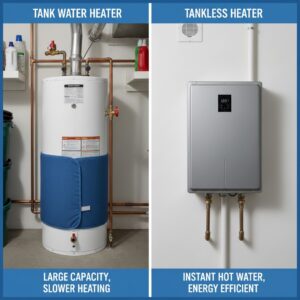
A traditional tank water heater stores a fixed volume of hot water—typically 40 to 80 gallons. The system continuously reheats water to maintain temperature, even when no hot water is being used.
Key implication: This “standby heat loss” increases energy consumption and operating cost over time.
Tankless (On-Demand) Water Heater
A tankless water heater heats water only when flow is detected.
There is no stored water. Heating occurs instantly through high-powered gas burners or electric elements.
Key implication: Reduced standby losses and higher efficiency—but performance depends on:
- Incoming water temperature
- Flow rate (GPM)
- Input power (BTU for gas, kW for electric)
Water Heater Efficiency: Understanding UEF Ratings
The Uniform Energy Factor (UEF) is the standard efficiency rating for water heaters.
Higher UEF generally means lower energy waste and lower operating cost.
- Standard gas tank water heater: UEF ~0.65–0.70
- Non-condensing gas tankless water heater: UEF ~0.80–0.82
- Hybrid heat pump water heater (tank): UEF 3.0+
Important note: Tankless water heaters are more efficient than traditional tanks, but hybrid heat pump water heaters are the most energy-efficient option overall.
Monthly Energy Savings: What Homeowners Actually Save
Real-world data shows that tankless water heaters save the most energy in homes with moderate daily hot water usage.
- ≤40 gallons/day: 24%–34% energy savings
- ≥80 gallons/day: 8%–14% energy savings
Bottom line: Tankless systems benefit smaller households or staggered usage patterns more than large families with simultaneous demand.
Hot Water Performance: Is “Endless” Really Endless?
Tankless water heaters provide continuous hot water only within their capacity.
- Gallons per minute (GPM)
- Temperature rise required
- Number of fixtures running at the same time
A tank water heater, by contrast, delivers a large first-hour volume, making it better for short, high-demand bursts.
Water Heater Installation Cost Comparison
- Gas tank water heater: $1,200 – $1,500
- Gas tankless water heater: $900 – $1,600
- Hybrid heat pump tank: $1,500 – $2,000
Smart Water Heater Technology & Smartphone Connectivity
- Remote temperature control
- Energy monitoring
- Leak and error alerts
- Smart scheduling
- Home automation integration
Final Verdict
There is no single “best” water heater—only the best option for your home, lifestyle, and long-term goals.