
Air Conditioning in South Florida
The “Two-Foot Rule,” Better Comfort, and Lower Bills
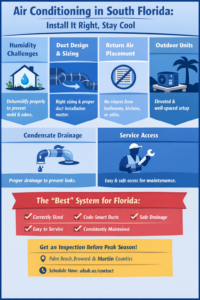
Air conditioning in South Florida isn’t optional. It’s what keeps your home livable, controls humidity, and protects finishes from moisture problems.
But here’s the truth most homeowners learn after a few seasons: the “best” air conditioning isn’t just a brand name or a high SEER rating.
The real win is a system that’s designed right, installed cleanly, drains correctly, moves air the right way, and stays easy to maintain.
In Palm Beach, Broward, and Martin County, I see the same story over and over: homeowners spend real money on new equipment, but comfort still feels uneven, humidity stays high, and electric bills don’t drop like they expected. Usually, the problem isn’t the box outside. It’s airflow and duct design.
One of the most practical duct rules you’ll ever hear is the Two-Foot Rule. It’s basic airflow physics that helps reduce static pressure, improves air delivery, and makes rooms feel more even.
Why Air Conditioning Works Differently in South Florida
Humidity is the real enemy
In Florida, your air conditioning system isn’t only cooling the air. It’s pulling moisture out of the house.
When indoor humidity stays high, you can get musty odors, clammy comfort, and higher risk of microbial growth.
Long runtimes punish bad installs
Florida systems run hard for most of the year. That means small install issues turn into big problems:
undersized returns, high static pressure, leaky ducts, sloppy condensate drainage, and poor service access that leads to skipped maintenance.
The Foundation of Air Conditioning Performance: Airflow and Duct Design
Sizing is not “bigger is better”
Oversized air conditioning cycles on and off too fast. The home cools quickly, but the system doesn’t run long enough to pull out moisture.
Proper sizing should be based on real load calculations, not guesswork.
Duct design is where comfort lives or dies
Ducts aren’t just “air pipes.” They’re an airflow system. If the layout is wrong, you’ll see hot rooms, weak airflow, noise,
higher bills, and equipment strain from high static pressure.
The Two-Foot Rule: A Simple Way to Protect Airflow
The Two-Foot Rule is a duct spacing principle that helps air re-pressurize after changes in direction or after air “escapes” down a branch.
In simple terms, air needs distance to stabilize so the next takeoff gets fed correctly.
- After an airflow change (elbow, transition, takeoff), airflow needs roughly 18–24 inches to recover and stabilize.
- Place takeoffs about 24 inches (two feet) apart so air has time to re-pressurize.
- Keep the last takeoff about two feet from the end of the trunk line.
- Avoid putting outlets or takeoffs in end caps, which can rob airflow from other branches.
Why it matters in Florida: long runtimes magnify airflow mistakes. If takeoffs are jammed together or placed too close to elbows/transitions, you can get weak airflow to certain rooms, more noise, higher static pressure, and worse humidity control.
Return Air: The Most Common Hidden Problem in Florida Homes
Supply air gets all the attention, but return air is where the system breathes. If return air is wrong, everything suffers:
comfort, efficiency, humidity control, and sometimes air quality.
In South Florida, return problems often show up as uneven temperatures, doors that suck shut when the system runs,
whistling at door gaps, and humidity that won’t drop even when the thermostat looks “right.”
Condensate Drainage: Small Mistakes Cause Big Damage
Florida air conditioning creates a lot of water. If the condensate drain setup is wrong, you’re not asking “if” it will cause damage, you’re asking “when.”
Good practice usually includes proper slope, a cleanout for service, and overflow protection—especially in attics.
Smart Thermostats: Florida-Friendly Savings (When the System Is Installed Right)
A smart thermostat won’t fix a bad duct system. But when your air conditioning is designed and installed correctly,
it can help you schedule smarter, control comfort remotely, and reduce waste without big comfort swings.
Florida tip: avoid extreme setbacks in summer. If you let the home heat up too much during the day, humidity can creep back in and recovery becomes harder.
Steady control usually feels better and can be cheaper.
What’s the Best Air Conditioning for South Florida?
The best air conditioning is the system that’s properly sized, paired with duct design that delivers airflow evenly,
installed with correct takeoff spacing (including the Two-Foot Rule), set up to drain safely, serviceable for maintenance,
and maintained consistently.
If you want a practical breakdown of equipment types and what fits different homes, start here:
https://ahub.us/what-air-conditioning-unit-is-best/
CTA: Want Your Air Conditioning Checked Before Peak Season?
If you’re in Palm Beach, Broward, or Martin County and you want air conditioning that runs cleaner, controls humidity better,
and doesn’t surprise you in July, the best next step is an inspection.
- Learn about our air conditioning services:
https://ahub.us/air/ - Explore ductless options:
https://ahub.us/mini-split-air-conditioning/ - Compare systems the smart way:
https://ahub.us/what-air-conditioning-unit-is-best/ - Schedule an inspection:
https://ahub.us/contact/