
Air Conditioning in Florida: Why Spray Foam Insulation and Inverter Systems Are the Ultimate Comfort Combo
As a Class A air conditioning contractor in Florida with more than 20 years of field experience, I’ve watched countless homeowners struggle with the same problems: high electric bills, uneven temperatures, sticky indoor air, noisy systems, and AC units that seem to wear out far too quickly.
In many cases, the issue isn’t the brand of the air conditioning system. It’s not even the SEER rating. The real problem is that the house itself is fighting the AC.
That’s why one of the most powerful upgrades available today—especially in South Florida—is combining spray foam insulation with a modern inverter air conditioning system (also called variable-speed or inverter-driven AC/heat pump). When these two systems work together, they don’t just improve comfort. They fundamentally change how a home performs in heat, humidity, and energy use.
Why Air Conditioning Works Differently in Florida Homes
Florida isn’t like most states. Air conditioning here runs longer, harder, and under more stress than almost anywhere else in the country.
Heat, Humidity, and Runtime
In South Florida, it’s normal for air conditioning systems to run 10–14 hours a day, nearly year-round. Even during “winter,” many systems still operate to control humidity. That means higher electrical demand, more moisture passing through the system, faster wear on components, and greater sensitivity to installation quality.
Any weakness in insulation, duct sealing, or airflow gets exposed quickly.
What Makes Spray Foam Insulation Different
Traditional insulation—like fiberglass batts or blown-in cellulose—slows heat transfer, but it does not stop air movement. In Florida homes, that’s a major problem.
Air Leakage Is the Hidden Enemy
Hot, humid air sneaks into homes through attic penetrations, electrical boxes, recessed lights, window and door gaps, and pipe/wire chases. Every bit of that air has to be cooled and dehumidified by your air conditioning system.
How Spray Foam Changes the Game
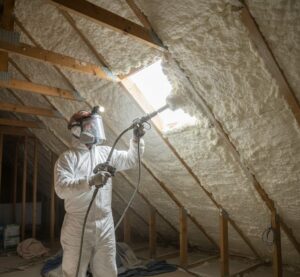
Spray foam insulation is applied as a liquid that expands and hardens into a solid foam, sealing gaps while insulating at the same time.
- Closed-cell spray foam – higher R-value, vapor resistant, excellent for Florida humidity
- Open-cell spray foam – softer, lower cost, excellent air sealing
The biggest advantage is air sealing. Spray foam can reduce air leakage by 70–90%, turning a leaky house into a controlled indoor environment. Think of it this way: fiberglass insulation is like a blanket with holes; spray foam is like shrink-wrapping the house.
What Is an Inverter Air Conditioning System?
Traditional air conditioning systems operate in an on/off pattern. They run at full capacity, shut off, then repeat the cycle. That cycling can cause temperature swings, poor humidity removal, higher electrical spikes, and more mechanical wear.
How Inverter Air Conditioning Works
An inverter (or variable-speed) air conditioning system works more like a dimmer switch. Instead of running at 100% or 0%, it can adjust output smoothly—often anywhere from 25% to 100% capacity.
- 20–40% lower energy use
- Much quieter operation
- Longer run times at low speed
- Superior humidity control
- More consistent temperatures
In Florida, many inverter systems are heat pumps, offering efficient heating during mild winters.
Why Spray Foam and Inverter Air Conditioning Work Better Together
These two upgrades don’t just stack benefits—they multiply them.
1) Spray Foam Reduces the Cooling Load
Your air conditioning system fights two things: heat entering the home and humid air leaking in. Spray foam dramatically reduces both. Real-world Florida results often show meaningful reductions in attic heat gain and overall cooling demand.
2) Inverter Systems Thrive in Low-Load Homes
In a leaky house, even the best inverter system is forced to ramp up frequently. In a spray-foamed home, the load is steady and low. That allows the inverter to run at partial capacity for long periods, avoid short cycling, and remove moisture more effectively—using far less electricity.
In many cases, we can even downsize the AC system by ½ to 1 ton, reducing upfront cost while improving performance.
3) Major Energy Savings in Florida
Air conditioning can represent 50–60% of the electric bill in many Florida homes. The combined upgrade can reduce cooling energy dramatically, which is why we often see summer electric bills drop from the $300–$400 range to the $150–$200 range, depending on the home.
4) Superior Humidity Control (Florida’s Biggest Comfort Issue)
Humidity—not temperature—is what makes homes feel uncomfortable. Spray foam blocks humid infiltration and inverter air conditioning runs longer at low speed, pulling more moisture from the air. Result: indoor humidity stabilizes around 45–55%, the home feels cooler at higher thermostat settings, and mold/mildew risk drops.
Real-World Florida Example
For a typical 2,000–2,500 sq ft Florida home, we commonly see:
- Cooling energy reduced by roughly 40–60% (sometimes more, depending on conditions)
- Lower run time and less wear on the system
- Better comfort across rooms (fewer hot/cold spots)
- More stable humidity control
Your exact results depend on windows, orientation, duct layout, and how leaky the home was before.
Is This Upgrade Right for Every Home?
Not always. Homes with major duct issues, poor airflow design, or outdated electrical capacity may need additional improvements first. That’s why a professional evaluation matters—especially in Florida where humidity and runtime expose weak links fast.
If you’re exploring air conditioning upgrades, these resources can help:
- Learn about our air conditioning services: https://ahub.us/air/
- Explore ductless and inverter mini-split options: https://ahub.us/mini-split-air-conditioning/
- Compare air conditioning systems objectively: https://ahub.us/what-air-conditioning-unit-is-best/
- Schedule a professional inspection: https://ahub.us/contact/
Final Thoughts: Air Conditioning That Actually Works With Your Home
Spray foam insulation turns your house into a thermal shell. Inverter air conditioning takes advantage of that shell by operating efficiently, quietly, and consistently. Individually, each upgrade is strong. Together, they transform how a Florida home feels, performs, and costs to operate.
It’s not the cheapest upfront solution—but in Florida’s climate, it’s one of the smartest long-term investments you can make in comfort, efficiency, and peace of mind.